
A new lead comes in at 10:17 on Tuesday morning.
The website sends an email to the owner. The ad platform sends another notification. The office manager assumes the salesperson saw it. The salesperson assumes the office manager called. At 3:30, somebody finally asks, “Did we ever answer that one?”
That is not a response-time problem. It is an ownership problem.
Contractors hear plenty of claims about replying in five minutes, ten minutes, or one hour. I would not build an operating system around a universal number pulled from somebody else’s sales deck. An emergency plumbing call and a kitchen-remodel form are different leads. Tuesday at 10 a.m. and Sunday at 2 a.m. are different conditions.
You need a response rule your team can follow, measure, and improve. Start with the type of lead, the customer’s likely urgency, and who owns the next action.
Define what a response actually is
An automatic “we got your request” text is useful. It confirms that the form worked and tells the customer what happens next. It is not the same as a person understanding the job and moving it forward.
Track two times:
- Acknowledgment time: How long it took your system to confirm receipt.
- Human response time: How long it took a person to call, text, or message with a useful next step.
If you mix those together, the report looks great while homeowners are still waiting. A bot can reply in seconds. That does not mean anybody knows whether the customer has a burst pipe, wants a roof inspection, or lives outside your service area.
A meaningful first response should do at least one of these things: answer the immediate question, confirm the job is a fit, collect missing details, schedule the next step, or set an honest expectation for when a person will follow up.
“Thanks, somebody will contact you soon” is an acknowledgment. “We handle that repair in your area. Can you send a photo, and are you available between 2 and 4 today?” is a response.
Use a different rule for each kind of lead
One blanket response-time goal sounds simple. It usually creates bad behavior. Your team races through low-priority forms while an urgent caller sits in voicemail.
Build a small service-level table instead.
Live calls and urgent service requests
Answer live when you can. If you miss the call, send an immediate text that identifies the company and asks what the caller needs. Then put the human callback at the top of the queue.
The automated text keeps the conversation open. The callback handles the job. If your current phone setup still sends every missed call straight to voicemail, fix that before you buy more ads. Our guide to missed-call text-back covers the basic setup.
For emergency trades, define what counts as urgent. “No heat with an infant in the house” belongs ahead of “I want a quote on a replacement system next month.” Your dispatcher should not have to invent that priority while six notifications are arriving.
Website forms and paid-ad leads
Send the acknowledgment immediately, then assign a person and a deadline during staffed hours. A form submitted at 11 a.m. should not sit until the end of the day because everybody thought an email notification counted as ownership.
Google’s current Local Services Ads guidance says leads can arrive as calls or messages and recommends responding as soon as they come in. Google also says consistently fast responses could improve ad ranking and the ability to receive leads. It does not give every contractor one universal minute target. That is the right distinction: move quickly, but set the exact rule around your operation and the kind of work you sell. You can read the current Google guidance on managing Local Services Ads leads.
A practical starting rule might be a human reply within one staffed business hour for normal quote requests. That is an operating target, not an industry benchmark. Run it for 30 days and see whether your team can hold it.
Social messages and marketplace requests
Facebook, Instagram, Angi, Thumbtack, Yelp, and similar channels create a second inbox whether you want one or not. If you accept leads there, somebody has to watch them.
Do not rely on the owner remembering to open five apps. Route the channels you actively use into one inbox, or assign each channel to a named person with notifications turned on. If nobody will monitor a channel, pause the campaign or remove it from the lead plan.
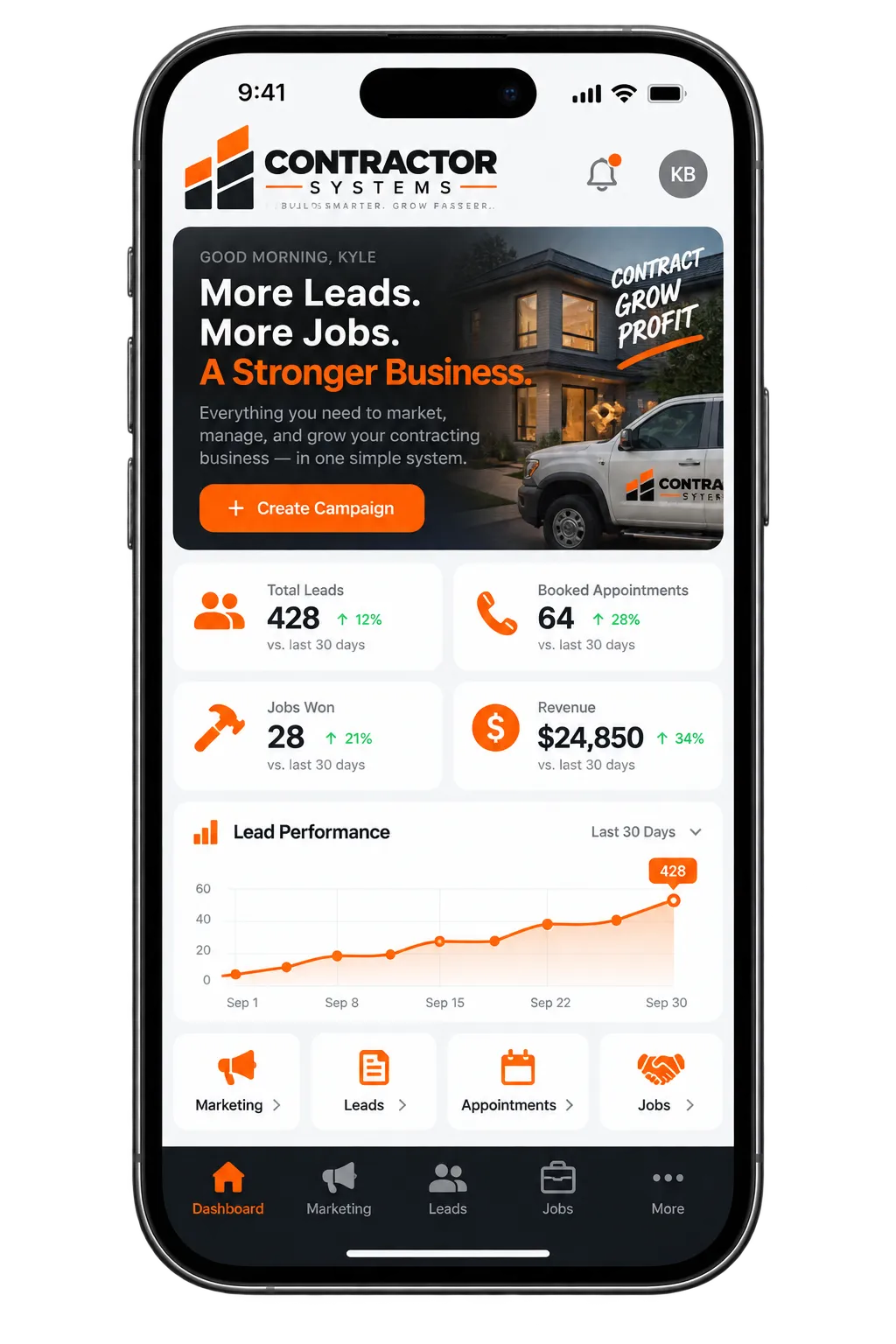
Contractor Systems connects lead sources and operating tools, but the software does not excuse a vague process. A unified inbox only helps when each new item has an owner.
After-hours leads
Do not promise a midnight callback if nobody is working at midnight.
Acknowledge the request, collect enough information to identify an emergency, and state the real next step. For example:
Thanks for contacting Ridgeview HVAC. We received your request. If you have no heat, smell gas, or have an active leak, reply URGENT. Otherwise, our office will call after 7:30 tomorrow morning.
Change the wording and safety instructions for your trade. A pool-service company does not need the same escalation language as an electrician.
If after-hours calls are frequent and valuable, use an answering service or receptionist that can qualify the request and book the next step. If they are rare, a clear acknowledgment plus a morning call list may be enough. Buy coverage for the problem you have, not the demo you watched.
Give every lead one owner
The person responsible for the first response should be obvious before the lead arrives.
For a small shop, that may be the owner during the day and an automated acknowledgment after hours. For a larger company, it may be the dispatcher for service calls, an estimator for project inquiries, and the office manager for web forms.
Use names, not departments. “Sales owns web leads” is vague. “Maria owns new web and Google leads from 8 to 5, and Devon covers lunch” can be tested.
Your system also needs an escalation rule. If the assigned person does not respond before the deadline, the lead moves to a backup. The backup should not discover the lead through a Friday spreadsheet.
Keep the handoff simple:
- New lead arrives with a source and timestamp.
- The system assigns one owner.
- The owner accepts it or responds.
- The system escalates it if the deadline passes.
- The owner records the outcome: booked, not a fit, unreachable, duplicate, or follow-up scheduled.
That last step matters. Fast response without a clean outcome just produces a faster mess.
Measure the response your customer received
Start with four numbers each week:
- New leads received
- Leads with a meaningful human response
- Median human response time during staffed hours
- Leads that missed your internal deadline
The median shows a normal lead experience. Also inspect the slowest group. Ten fast replies can hide one lead that sat for two days.
Break the report down by source. Phone leads may look healthy while Facebook requests go untouched. Website forms may be fast during the week and terrible on Saturday. The blended number hides the exact place that needs work.
Exclude duplicates, spam, current-customer service messages, and job applicants from the new-business metric, but document the rule. Do not quietly remove slow leads because they make the report look bad.
Then compare response time with the outcomes you already track: appointments set, estimates created, jobs booked, and leads marked not a fit. You are looking for where your own process breaks. You do not need an invented national average to see that one source keeps aging out with no owner.
The Contractor Systems results page shows the operating measures we use, including response time by call, form, text, or Google message. The value is not the dashboard itself. The value is seeing the exception while the lead can still become a job.
Run a one-week lead-response audit
For the next seven days, log every new inquiry from the moment it arrives.
Write down the source, arrival time, assigned owner, acknowledgment time, human response time, next step, and final outcome. Review the missed deadlines at the end of the week without turning it into a blame session.
You will probably find one of three issues: notifications go to the wrong person, after-hours expectations are unclear, or two people both think the other owns the reply. Fix that before changing the target.
Fast matters. Clear ownership matters more. Set a response rule that matches the lead, make one person responsible, and measure the response the homeowner actually received.
Contractor Systems puts calls, forms, ad leads, texts, and follow-up in one place, with a named next step instead of another notification. See the lead flow in action, then compare it with how your team handles a new inquiry today.